
Sherzad MamSani
President, Israel–Kurdistan Alliance Network, EastMed News Contributor
What is presented in this article is neither fabrication nor political imagination. It is an analytical reading grounded in original texts quoted verbatim from the thought and philosophy of the leader of the Kurdistan Workers’ Party (PKK), Abdullah Öcalan, as articulated in his book (My Defense: A Turning Point on the Path of the Democratic Solution), in addition to official documents published on the website of the Turkish Parliament concerning the Imrali meeting of 2025.
These texts are presented for examination, critical reading, and analysis, in order to understand the long-term strategy adopted by this current, taking into account more than forty years of armed struggle by the PKK. That struggle began under the slogan (Establishing a Greater Kurdistan) and waged a prolonged conflict against the Turkish state, during which the Kurdish people paid enormous human and political costs, without yielding any tangible national outcome.
I. The General Ideological Framework and the Question of National Rupture
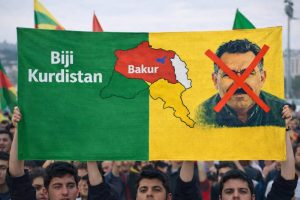
Since its inception, the PKK has pursued a confrontational approach toward most other Kurdish political forces and factions across Kurdistan, bypassing widely shared national foundations, most notably:
• Replacing the name (Peshmerga) with (Guerrilla) for its armed forces
• Adopting a flag different from the nationally agreed Kurdish flag
These two symbols were not merely formal details; they represented elements of unity and collective national identity within Kurdish consciousness. Nevertheless, they were deliberately sidelined within a distinct ideological project.
II. Öcalan as He Presents Himself in His Own Writings
In his book (My Defense: A Turning Point on the Path of the Democratic Solution), Abdullah Öcalan states explicitly, particularly on page 173:
(Just as much as we strive to distance Turkey from danger and save it from the great risks awaiting it, we also desire Turkey’s return to the power and greatness it once possessed.)
This passage is neither selective nor interpretive; it is a literal quotation. Here, an unavoidable central question arises:
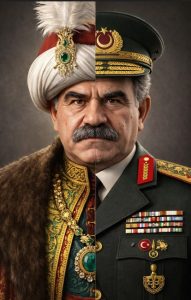
How does Öcalan’s project differ from that of Recep Tayyip Erdoğan?
If both figures, each in his own way, are working toward restoring Turkey’s (historical power and greatness), meaning a renewed Ottoman legacy in modern forms, then what justifies the shedding of Kurdish and Turkish blood alike over decades if the ultimate objective is the same?
III. The Final Settlement and the Service of the Turkish State
Öcalan continues in the same work by elaborating on what he calls the (final settlement), stating:
(With the final settlement, the military and combat capacities of the PKK will enter into the service of the Republic of Turkey, and the threats endangering its existence will disappear—threats driven by certain global power centers exploiting the Kurdish question for two hundred years to inflame Turkey and turn it into a permanent war zone, as they did in Kosovo, Lebanon, Bosnia and Herzegovina, Iraq, and particularly in northern Iraq under the designation of the Kurdish entity.)
Here, pressing questions impose themselves:
What final settlement is Öcalan referring to?
Is there even an existential conflict with the Turkish state that necessitates a settlement, if the declared project is to save and protect that very state?
More critically, Öcalan presents himself and his party as a strategic savior of Turkey from global conspiracies, viewing the military force built by the PKK as an instrument to safeguard the Turkish state rather than to confront its occupation of half of Kurdistan.
IV. The Position on the Kurdistan Region of Iraq and Kurdish Syria
This approach becomes explicit with the establishment of the Kurdistan Regional Government in 1992, when Öcalan declared that entity to be (a poisoned dagger in the flank of the Turkish state), declared war against it, and described it as a product of imperialist powers.
The paradox lies in the fact that these same (imperialist powers) later provided political and military cover to the PKK in (northeastern Syria). Moreover, Öcalan explicitly denied the existence of (Western Kurdistan) in an interview published in the booklet (Seven Days with Apo: Leader and People), despite his movement imposing control over the area by force since the outbreak of the Syrian conflict.
Following his arrest and during his trial, Öcalan stated that he had rendered (great services to Turkey) by standing alone against the establishment of a Kurdish state in northern Iraq. This stance continues to define his party’s position to this day, aligning fully with the Turkish state’s categorical rejection of any Kurdish national entity—even if it were (on Mars).
V. The Imrali 2025 Document and the Confirmation of the Trajectory
The officially published Imrali meeting document of 2025 confirms this trajectory beyond any doubt. In it, Öcalan states:
(Israel seeks to establish a Kurdish state in order to secure its regional dominance, and I oppose this. I defend regional democracy and communes within the unity of Syrian territory.)
He further adds:
(If I am granted the practical and theoretical opportunity, I am ready to serve the Turkish state.)
These statements, issued within an official Turkish parliamentary document, leave no room for ambiguity: the rejection of a Kurdish state is a fixed strategic choice, not a temporary maneuver.
VI. Implications for Rojava Today
In practical terms, this trajectory is clearly reflected in northern and eastern Syria. Prior to the collapse of Assad regime authority across large parts of the country, the United States made a direct request to the Syrian Democratic Forces (SDF) to assume responsibility for managing the transitional phase politically and militarily.
This option was raised in closed meetings between 2019 and 2022 but was rejected on the grounds that SDF was (a revolutionary force that does not operate under external orders). In reality, the decision was deferred to Qandil under the pretext of (preserving the peace process) in Turkey.
As rejection persisted, Washington informed SDF that the opportunity would not remain open and that other actors would be tasked with the mission, which subsequently occurred, marking a decisive turning point.
VII. Misreading the Relationship with a Great Power
This path raises a fundamental question:
How can a military force that receives training, funding, and air cover from the Pentagon construct its ideological discourse around opposition to the political and value system represented by the United States?
Washington repeatedly warned against this contradiction. The clearest expression came from former U.S. National Security Advisor John Bolton, who stated:
(We are allied in Syria with a partner that holds ideological conceptions incompatible with us.)
In light of the above, it can be concluded that the absence of political pragmatism, and the prioritization of ideology over sovereign decision-making, resulted in the squandering of a rare historical opportunity.
Had international realities been approached with greater realism, rather than through projects aimed at saving Turkey from fragmentation, it would have been possible for Mazloum Abdi to occupy a sovereign decision-making position today, rather than being confined to a limited security role within a complex regional equation.
References and Notes (Unified)
1. Abdullah Öcalan, (My Defense: A Turning Point on the Path of the Democratic Solution), p. 173.
2. Abdullah Öcalan, (Seven Days with Apo: Leader and People).
3. Official website of the Turkish Parliament, (Text of the High-Security Prisoner Imrali Meeting), 24 November 2025.
4. Reuters, reports on U.S.–SDF relations (2016–2024).
5. Associated Press (AP), coverage of U.S. policy in northern and eastern Syria.
6. International Crisis Group, reports on the PKK and the Autonomous Administration.
7. Carnegie Middle East Center, studies on the Syrian Kurdish question.
8. Official statements and speeches by Abdullah Öcalan and Recep Tayyip Erdoğan published in Turkish media.